[emsev_ml:00449] Solidarity, help, exchange of knowledge
Dear Friends and Colleagues from Japan,
I, my friends and colleagues are with you in front of natural and anthropogenic catastrophes!
We believe that the Japan people will overcome soon the enormous consequences!
Please, visit our web site ( http://theo.inrne.bas.bg/~mavrodi/ ) to see that if Japan Geomagnetic Intermagnet stations used our analysis, they could wait the imminent increasing of seismicity in the region.
We are ready to discuss the Collaboration with Japan colleagues for researching the possibilities for solving the "when, where and how" earthquakes prediction problem on the basis of complex monitoring and inverse problem nonlinear analysis.
The Japan Intermagnet stations have local geomagnetic, Earth electricity and Vertical electrical current measurements with almost appropriate samples/second. So we can start the test our Research program.
Concerning the refrigerating efforts,we would like to propose the using of slow down (better liquid) metals like aluminum, lead,(mercury ?),..., ftor, but not H2O. Please, remember the technology of Submarine reactors.
Strachimir Chterev Mavrodiev,
Coordinator of FP7, IRSES Project "Complex Research of Earthquake’s forecasting possibilities, seismicity and Climate change correlations"
P.S.1. Please, inform the Nuclear and Governmental authorities for our mail.


2011年3月23日13:31
件名(smart:00775) WellWeb:産総研の地下水等観測データ公開HPについて:再開しました.
児玉様,皆様
小泉です.
・下記URLにて,データ公開を再開しました.
当面,1日1回手動で更新します.
(したがって,土日と祝日は休みます.)
http://unit.aist.go.jp/actfault-eq/tectonohydr/
*このメールは自由に転送していただいて結構です.
http://unit.aist.go.jp/actfault-eq/tectonohydr/topics/wellweb/water/display_list.html の3ヶ月データをざっと見たところ、preseismicを含むcoseismicな変化が見えるのは、以下の観測点でした。000 草薙(静岡県静岡市) 002 浜岡(静岡県御前崎市) 004 豊橋(愛知県豊橋市) 005 豊橋東(愛知県豊橋市) 006 豊田下山(愛知県豊田市):降雨増加後coseismic 007 安濃(三重県津市) 009 海山(三重県紀北町) 010 井内浦(三重県熊野市) 011 本宮三越(和歌山県田辺市)preseimic? 
012 串本津荷(和歌山県串本町) 014 板東(徳島県鳴門市) 015 阿南桑野(徳島県阿南市):降雨増加かな・・・ 016 松山・奥道後(愛媛県松山市) 017 宇和(愛媛県西予市) 019 高知市(高知県高知市)preseimic? 
022 伊東1(静岡県伊東市) 026 秦荘(滋賀県愛荘町) 坑内歪 027 花折(滋賀県大津市)、大原(京都府京都市) 028 黄檗(京都府宇治市)、広陵(奈良県広陵町) 029 天王寺(大阪府大阪市) 坑内歪 030 宝塚(兵庫県宝塚市) 031 安富・安富北(兵庫県姫路市) 坑内歪
北朝鮮労働新聞「動物の異常行動や地下水の水位変化で地震を予知できる」
2011.3.20 22:30
北朝鮮の朝鮮労働党機関紙「労働新聞」は20日、動物の異常な行動や地下水の水位変化などで、地震を予知できるとする地震局専門家の解説記事を掲載した。北朝鮮メディアは東日本大震災の被害を連日報道しており、地震予知への関心が高まっていることを反映しているとみられる。
同紙はまた、震災で事故を起こした福島第1原発の3、4号機の空撮写真を初めて掲載。同原発から漏れ出たとみられる放射性物質が米カリフォルニア州でも観測されたと報じた。
朝鮮中央通信は、福島原発事故に関連し、米国や中国が放射性物質の観測データなどを正確に通報するよう日本側に求めていることや、自民党の谷垣禎一総裁が17日の会見で「原子力政策の推進は難しい状況になった」と表明したことなどを伝えた。(共同)
* 失敗したら収容所に送られそうでやです・・・
「津波のときは井戸を見ろ」 先人の教えで津波避け助かる
2011.3.16 13:18
「津波の時は井戸に気をつけろ」。岩手県大槌町栄町の佐藤綾子さん(59)は二十数年前に近所の高齢者から聞いたこんな教えを覚えていて、津波から逃げ延びた。「昔聞いた話が本当に役に立つとは」と先人の知恵に驚いた様子だった。(清作左)
佐藤さんは二十数年前、当時小学生だった長女(32)と、学校の学習発表会のために津波について勉強していた。
そのとき、明治29年に起きた明治三陸大津波に被災した近所のお年寄りから体験談を聞いた。「津波の時は井戸の水が引いて、ゴボゴボという音がする。井戸には気をつけて」と佐藤さんは振り返る。それ以降、「津波が来そうな時はとにかく井戸を見る」と肝に銘じていたという。
この知恵が今回の震災で生きた。揺れが収まった後、佐藤さんはすぐに自宅の井戸をのぞいた。「(井戸の水が)今まで見たことないぐらいに真っ茶色に濁っていた。これはまずいと思って、すぐさま逃げた」
自宅は津波に飲み込まれたが、佐藤さんは高台に逃げて助かった。
高台から見ると、町に煙がたなびいていた。「よく見ると水しぶきだった。あんなに近くまで来るなんて…」と今回の津波の壮絶さを語った。
「先人の教えは大事なんだと、今回のことで教わりました」と笑顔を見せた。
ビールで放射線をブロックできるかもしれないんですって
「5分で済むような問題を、日本人は委員会をつくって延々と議論する。
責任者を見つけるのは困難で、副大臣以下と話しても意味がない」
2011年3月11日14時46分(JST)に発生した地震による電離圏プラズマの変動(GPS-TEC Homepage) 2011年3月11日14時46分の地震発生後に国土地理院のGPS受信機網GEONETによって観測された電離圏プラズマの変動です。電離圏は高度100kmから1,000kmにかけて広がる大気の一部が電離してプラズマになっている領域です。GPS受信機によるプラズマの観測は、最も密度の高い高度300km付近のプラズマの密度を最も反映していると考えられます。
地震は、地中の波(地震波)、海洋の波(津波)だけではなく大気の波(音波、大気重力波)を起こし、その大気の波は高度300kmまで到達して、広がっている様子が分かります。2011年3月11日東日本太平洋沖地震に伴う電離圏擾乱 (NiCT) 2011年3月11日14時46分(JST)に三陸沖で発生したM9.0 の地震発生数分後に、大気波動(音波や重力波)が電離圏F 領域(250km 付近)まで到達したことを示す現象が、宇宙環境計測グループによる多地点GPS 観測データ解析で確認された。図2 から、震源を中心として同心円状に波が広がる様子がわかる。地震を発生原因とする電離圏内部の波が等方的に伝わる様子を詳細に可視化したのは、今回が世界で初めてである。
なお、この地震に伴う電離圏変動は、通常の変動に比べて大きくなく、GPS 測位やHF 通信、衛星通信への影響はほとんど無いと判断している。
Ukrainian seismic monitoring station records Japan earthquake and blast (Kyiv Post) The main special monitoring center of the State Space Agency of Ukraine (SSAU) has been recording all of the earthquakes that have struck Japan over the last few days, the center told Interfax-Ukraine on Monday.
"The PS-45 seismic monitoring station in Malyn (Zhytomyr region) recorded all the tremors in Japan over the last few days, including an explosion at the nuclear power plant in Fukushima. The online monitoring of the situation is currently continuing," a center representative said. .
He noted that several years ago, Ukrainian experts had drafted a project to create the Ionosat satellite earthquake warning system.
"Unfortunately, due to the lack of funds, the introduction of the system is expected in Ukraine no earlier than in 2015-2017," he said.
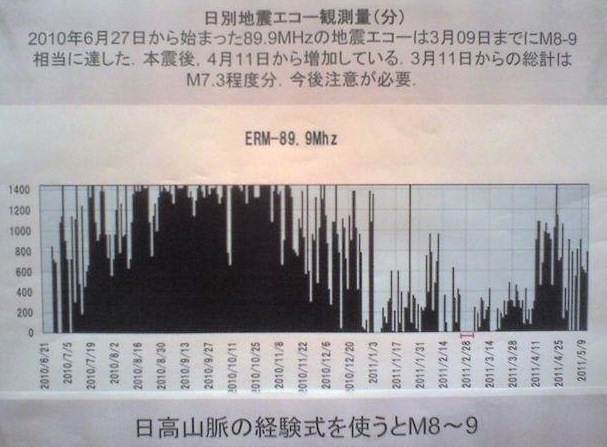
The Ukrainian PS-45 seismic monitoring station in Malyn is a list of objects of the international system of control over the implementation of the Comprehensive Nuclear-Test-Ban Treaty (CTBT).8カ月前から電波異常 北大研究グループ観測 「地震前兆の可能性」(北海道新聞) 未曽有の被害をもたらした東日本大震災の約8カ月前から、東北地方のFM放送の電波が強くなる電波異常が続いていたことが、北大の研究グループの観測で分かった。道内の過去の大地震発生前にも同様の異常があり、同グループは「前兆現象の可能性がある」とみている。
観測したのは、地震の予知に取り組んでいる北大地震火山研究観測センター研修支援推進員の森谷武男博士(元北大助教授)のグループ。2002年から、ふだんは200キロ以上離れた場所や山などの障害物がある地域では受信できないFM放送向けのVHF帯(超短波)が地震発生前になると、到達しない地域にまで届くようになることに注目。「地震発生前の岩盤破壊で電磁波が発生し、その影響で電波が散乱する」との仮説を立て、道内11カ所に観測用アンテナを設けて電波の変化を観測してきた。
大地震前に電波異常観測(十勝毎日, 2008.10.7)
マグニチュード(M)7・1を記録した08年の十勝沖地震では、地震発生10日前までの約40日間にわたり通常の2倍の強さの電波を観測。04年の留萌南部地震(M6・1)でも同様の現象が見られた。
今回は昨年7月ごろから異常を観測、日高管内えりも町と札幌市南区の観測地点ではほぼ毎日、岩手県のFM局の電波の強さが通常の2〜3倍になった。大震災40分前上空の電子急増 チリ地震と類似「前兆か」(北海道新聞) * 日置先生より:この記事は政治部の記者さんが書いたものなので色々と不正確です。鋭意論文化していますので、投稿までは外国の研究者に紹介するのは猶予下さい。
国内最大のマグニチュード(M)9・0を記録した東日本大震災の40分前、震源地上空の電子の量が局地的に増えていたことが、北大理学研究院の日置(へき)幸介教授(地球惑星物理学)の調べで分かった。日置教授は震災後、昨年のチリ地震(M8・8)をはじめ、過去の大地震直前にも同様の現象が起きていることを確認。「電子の急増は、巨大地震の前兆の可能性がある」とみている。
日置教授によると、国土地理院の衛星利用測位システム(GPS)観測網のデータを基に、地上約80〜500キロの電気を帯びた空気の層である「電離層」の電子の量を解析した。
その結果、11日午後2時46分発生の巨大地震から40分余り前の午後2時以降、震源地の三陸沖の上空で、電子の量が通常より2割ほど増えたことが分かった。
日置教授はこうした内容を26日、京都府木津川市で開かれた地震予知研究シンポジウム(国際高等研究所など主催)で発表した。地震発生のメカニズムに詳しい上田誠也東大名誉教授は「電離層での電子の急増が巨大地震の前兆現象であれば、興味深い。地震予知の研究に役立つだろう」と期待する。This man predicted the Japan quake (Channel NewsAsia) "We found very conspicuous anomalies on the date of March 5 and 6, on particular path from Chofu to American transmitter NLK. And probably it must be a precursor to big huge earthquake," prof Hayakawa said.
→速報:2011年3月11日の東北太平洋沖地震の前兆は?(地震解析ラボ)
太平洋上空の電離層、震災前に異常 電通大が観測(日経)
東日本大震災が発生する5〜6日前に、太平洋上空の電離層に著しい異常があったことが、電気通信大学の早川正士特任教授らの観測で分かった。内陸の直下型地震の予測を目指して研究を進めているが、東海地震などプレート型の巨大地震にも有効とみている。
早川特任教授らは、地震が起きる1週間ほど前に、震源の上空約80キロにある電離層が低くなるという現象に着目する。
今回、米西海岸ワシントン州の送信局と、東京、愛知、高知の3カ所の受信局をそれぞれ結ぶ海域の上空で、3月5〜6日に超長波電波の夜間の平均振幅が極端に短くなり、電離層が低くなる状態を観測したという。
電磁気を手掛かりに地震発生を予測する研究は1990年代後半に国の研究資金で実施。欧州、インド、ブラジルでも電波を使った地震観測網をつくっている。
Tsunami Deaths and Damages Could Have Been Avoided, Italian Scientist Tells EIR (EIR) Comments from Prof. Biagi: The data reported by the journalists are not correct at all! The precursor I said is not on the radio data but on the GPS location of a laboratory.東日本大震災は予報可能だったのか?
Practically, some physics working in a laboratory located at about 300 km from the epicenter regarding the neutrino physics are collecting the GPS data (latitude, longitude and altitude) of their site from October 2010.
On March 1, 2011 an abrupt decrease of the altitute started and it continued till March 11 reaching the value of -3 meter. This information was given to me as private communication and I obtained by the responsible persons of the experiment the permission to divulgate only as private communication.
I attach the comunication I made at EGU Assembly as part of a my poster because I think that this communication could be divulgate. I hope to be able to obtain more data and informations at this regard in future.バリ大学の物理学教授であり地震予報研究の第一人者であるイタリアのピエール・フランシスコ・ビアッジ氏は、オーストリアのウィーンで行われる西欧地球科学会議(4月4日から8日まで)にて、日本で起こった地震は3月1日付けで、つまり実際の地震の10日前に予測されていた事実を発表することになっています。April 1, 2011 (EIRNS)—Japanese scientists had detected precursors of a large earthquake on March 1, ten days before it struck, Professor Pier Francesco Biagi told EIR today. Biagi is the leading Italian researcher on Earthquake precursors. He pointed out that if a government agency had been in place, evacuation measures could have been implemented and the tsunami would have claimed no victims and caused no damage, including at the Fukushima nuclear plant.
The warning would have not stopped the tsunami and the destruction of the pumps, he stated, but the advanced warning would have provided the time to shut off the reactors ten days in advance of the earthquake, instead of ten minutes, as actually happened. This could have ensured the safe cooling of the reactors, he noted. Biagi said that his Japanese colleagues will present the evidence at the coming General Assembly of the European Geosciences Union, which will take place in Vienna April 4-8.
It is not clear whether Japanese scientists did warn the government, but that nothing was done, or, more probably, whether their warnings were turned down by the "scientific community."
Prof. Biagi welcomed Lyndon LaRouche's proposal to restart the U.S. National Earthquake Hazards Reduction Program (USNEHRP), and to integrate NASA into it. He said, however, that the original flaw of establishing a deadline for results, must be corrected. You cannot, say, that "in ten years we will analyze results, which were the conditions imposed on the USNEHRP, and, on the basis of those conditions, that, we will decide whether the funding should continue." He said it must be an open-ended program: it could be the case that in ten years, not enough results have been collected, because of a low level of activity; but it could be that enough results would be achieved in only three years, because of a high level of activity.
If he were the head of NASA and could decide on programs to finance for earthquake precursors, Biagi said he would immediately start a "very selected program of nano-satellites." The first nano-satellite would cost one million euros, and each successive one 600,000 euros. In reality this amount is peanuts, but there is no government financing of that. The Italians tried a couple of years ago to promote a European program, but they did not succeed.
Governments prefer to finance other programs, such as "the coupling of polar bears," he said ironically.
France was the only nation that sent a satellite in orbit specifically for earthquake research, with its Demeter satellite. Its data were "very interesting," Biagi said.
We are definitely in a phase of high level earthquake activity, Biagi observed. It is evident that seismic cycles coincide with sun activity.
Research of precursors is currently done in very few countries, and these are, in order importance of programs: Japan, Italy, Greece and Russia.
Those scientist groups meet regularly and coordinate their activity. Biagi works closely with Hayakawa and Molchanov, among others. The problem is that none of those programs are government-financed and scientists must organize private financing, sometimes in quite ingenious ways.
The Italians are collecting and evaluating data detected by a network of transmitters throughout the world, which are otherwise used for other purposes. They collect data on electromagnetic activity in advance of earthquakes. They are able to forecast with ten days of lead time, and with a probability of more than 80% accuracy, that a major earthquake will hit a certain region. Of course, the locality cannot be indicated with absolute precision, but within approximately a 100 km radius.
* 関連:Possible seismo-ionosphere perturbations revealed by VLF signals collected on ground and on a satellite (NHESS)注:単独測位による誤差のようです・・・
* 参考:International Network for Frontier Research on Earthquake PrecursorsEGU General Assembly 2011 NH4.1/SM5.8 Seismo electro-magnetic phenomena and earthquakes precursors
NH4.3/SM5.1 Seismic hazard evaluation, precursory phenomena and reliability of prediction
Papers of Special Interest in NH4.1: Seismo electro-magnetic phenomena and earthquakes precursors
Papers of Special Interest in NH4.3: Seismic hazard evaluation, precursory phenomena and reliability of prediction
Special session on earthquake and tsunami disaster in Japan | EGU MediaEGU2011-9105
Lithosphere-Atmosphere-Ionosphere Coupling (LAIC) model - an unified concept for earthquake precursors validation
Sergey Pulinets and Dimitar Ouzounov
Thu, 07 Apr 2011, 15:45–16:00, Oral, Room 11
Contact: S. Pulinets
Japan Quake Precursors
* 関連:Lithosphere-Atmosphere-Ionosphere Coupling (LAIC) model - An unified concept for earthquake precursors validation (Journal of Asian Earth Sciences)Was the Japanese Earthquake Forecastable? (Just World) Pier Francesco Biagi, a professor in the physics department at the University of Bari, and the leading researcher on earthquake precursors in Italy, has announced that he will be presenting shocking evidence, during an upcoming meeting of the European Geosciences Union in Vienna, Austria this week, that he and his team of researchers possessed knowledge of the major possibility of an impending earthquake which would hit Japan within a window of ten days, as early as March 1st. The earthquake hit precisely ten days later.
How could Biagi have known?
Professor Biagi and his team of researchers have been working for several years on the study of how changes in Very Low Frequency and Low Frequency radio waves can indicate areas of possible future seismic activity. Anomalies in this low band radio environment have been shown, by Biagi, to correlate with major seismic events. Using this method, Biagi's team insists that earthquakes can be forecast up to ten days in advance, with a higher than 80% probability, within a given 100km radius.
The key to Biagi's method is the use of ground-based radio transmitters coupled with orbiting satellites. Biagi’s team has depended in large part on the now-offline DEMETER satellite, launched in 2004 by the French Space Agency to measure the relationship between ionospheric disturbances and seismic events. Data from this satellite and from ground sensors was used by Biagi and his team to monitor anomalous changes in the ionospheric and atmospheric low band frequency radio ranges.
* 参考: International Network for Frontier Research on Earthquake PrecursorsSeimology Early Warning System Seminar (CITRIS, 2011.4.5)
Russian specialists intend to develop methods of earthquake prediction based on space programs (Roskosmos, 2011.4.7)
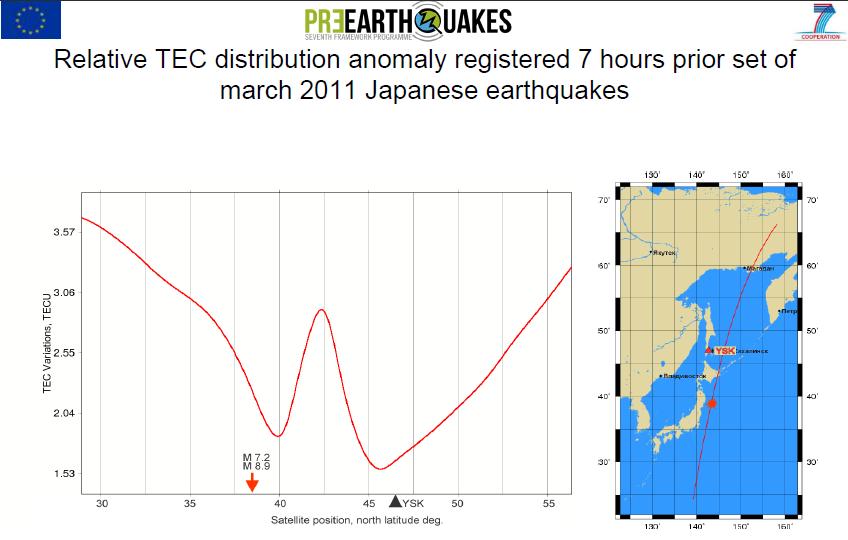
"For seven hours before the first tremor on 8 March in Japan, we predicted that there could be some kind of cataclysms," - said Yuri Urlichich during the meeting.
According to Yu Urlichich, information was obtained through monitoring the Earth's ionosphere.
He also said that several years ago, the European Space Agency chose the JSC "Russian Space Systems as a co-executor of the program on the prediction of earthquakes based on space systems.
For its part, Director General of Federal State Unitary Enterprise Central Research Institute of Machine Building, Gennady Raykunov said that "today there is no unambiguous data and credible signs that precede an earthquake." At the same time, he said, "there is a correlation between the geophysical phenomena in the near-Earth space and the subsequent catastrophic events." "In order to forecast earthquakes are also conducted experiments on the Russian segment of ISS. Created Roscosmos and Sciences Coordinating Scientific-Technical Council has allowed a new approach to the planning of such activities on the ISS. This, in essence, a new mechanism of research in space," - noted he said.
G. Raykunov also said that at present developing the concept of a space means to prevent asteroids and comets.
→The PRE-EARTHQUAKES Project
Romanov, RSS Contribution to Pre-Earthquakes, Pre-Earthquakes Kick-off Meeting, Potenza, March 15, 2011Report from Vienna: A Firsthand View of the Battle for Earthquake Forecasting (EIR) Especially the Japanese have been having problems getting any kind of state funding, because there seems to be a real, well, I would say a real skunk named Robert Geller, who, in his function at the University of Tokyo and the Earthquake Research Institute, has, as one of the participants told us, systematically been involved in shutting down any state grants. This section of the Tokyo University has the power to distribute funding into precursor research, and it's all going to strictly seismological research, and everything that the researchers we talked to come up with, is systematically attacked, and shot down. And one participant was able to tell us that this happened to one of his colleagues personally. That's definitely something where they see it, but they have a kind of idealism that comes from being a real scientist, that they don't expect a return, they don't expect recognition or gratification, but they know that it's important.Chinese satellite seeks to predict earthquakes | 中国の衛星は地震を予測しようとしている (SciDev.Net, 2011.4.19) [BEIJING] China will start building a test satellite later this month (April) to detect electromagnetic anomalies in the atmosphere, as part of the country's proposed earthquake monitoring network, and hopes to launch it in 2014.
The China Seismo-Electromagnetic Satellite (CSES) has been in development since 2003 and is the first spaced-based component of the network. Its data will be correlated with data from ground-based monitoring systems.
The network is eventually intended to provide advance warning of earthquakes, such as the one off the coast of Japan last month (11 March).
Strong seismic activity often causes electromagnetic anomalies in the Earth's atmosphere and magnetic field, aiding the monitoring and prediction of earthquakes, studies suggest.
Shen Xuhui, a senior researcher at the Institute of Earthquake Science, China Earthquake Administration (CEA), and leader of the CSES working group, said the satellite will eventually be connected to a larger observation system. China hopes to launch another two satellites by 2017 and begin predicting earthquakes from 2020.
Michel Parrot, principal investigator of the French DEMETER (Detection of Electro-Magnetic Emissions Transmitted from Earthquake Regions) microsatellite that studies similar anomalies, told SciDev.Net: "The CSES will study [electromagnetic] disturbances during seismic events. DEMETER has very often observed similar disturbances."
Simple data are not enough, however. "When you record a disturbance, you need to ensure that it is not caused by another factor, by comparing it with data at other locations," he said.
China's network is more ambitious than existing systems because it will use several satellites. "With a single satellite you can survey a given area for only a few minutes a day. With several satellites you can monitor a given location more often — if a disturbance is continuously observed at the same place, it is more reliable," added Parrot.
Since the DEMETER mission began six years ago, CEA researchers have been helping to analyse the data. China has also been working with other countries, including Italy, Russia and the Ukraine, that have their own seismo-electromagnetic systems.
Sergey Pulinets of the Fiodorov Institute of Applied Geophysics in Russia said that China has a more complicated task because, whereas DEMETER shows that earthquake precursors can be monitored from space, CSES will attempt to predict earthquakes. He said it could "make an important contribution to mankind's safety and prosperity".
Two days before Japan's earthquake last month, Chinese researchers detected abnormal electromagnetic signals in the area using ground-based systems, Shen told SciDev.Net. Following the earthquake, they analysed the signals and are sure these "have a close relationship" with the earthquake.
But the technique is still experimental and poses a risk of false alarms. "We therefore didn't do prediction or make any announcements," Shen said.Portents of earthquakes (RUVR, 2011.5.8) Russian and foreign experts will study the signs of earthquakes together. On the European part, the participants in the project are Germany, Italy and Turkey; NASA, representing the USA, and Greece are associated members. Russian science is represented by the Russian Space Systems company, the Fedorov Institute of Applied Geophysics and the Pushkov Institute of Terrestrial Magnetism, Ionosphere and Radio Waves Propagation.
As early as 2006, the Russian Space Systems company built a network of ground stations to monitor the ionosphere on the island of Sakhalin. Scientists analyzed changes in this upper layer of the atmosphere caused by seismic activity. Since that time, Russian satellites have more than once registered ionospheric disturbance ahead of earthquakes. Seven hours before the first tremors in Japan, scientists discovered similar anomalies over the site of the forthcoming disaster.
Atmosphere Above Japan Heated Rapidly Before M9 Earthquake (Technology Review, May 18) Infrared emissions above the epicenter increased dramatically in the days before the devastating earthquake in Japan, say scientists.* Atmosphere-Ionosphere Response to the M9 Tohoku Earthquake Revealed by Joined Satellite and Ground Observations. Preliminary results (arXiv) Do earthquakes give off warning signals? (ABC, May 20)
The March 11 earthquake in Japan was a magnitude 9.1. A team of scientists monitoring quakes there say they could tell it was coming because the atmosphere above the epicenter was heating up from eight days before.
Russian scientist Dimitar Ouzounov says stresses on the Earth's crust leading up to a quake cause gases like radon to escape into the atmosphere -- 100 miles above the Earth they ionize and create heat that is detectable by satellites. Ouzounov's team says out of 24 quakes in Japan of magnitude 7 or greater, all showed the same atmospheric signals beforehand.
"His interpretation from my perspective is not the last word," says NASA Ames scientist and researcher Friedemann Freund, who agrees the atmosphere heats up, but not from escaped gases. He thinks as stresses on the Earth's crust build toward a quake, massive air ionization is a measurable result. But still, he cautions prediction is too strong a word.
"We will never be able to predict," he says. "We can forecast, like the weather service forecasts certain weather conditions, and the reason is whatever we do we can only detect the stress buildup in the Earth, not the earthquake itself."
"We've also learned a lot about the physics of failure of the Earth's crust and it is not reassuring," says USGS geophysicist Malcom Johnston, who believes quake precursors happen at such tiny places on a fault, it's impossible to know for sure what's coming. However, he says it's important to keep looking. "We are very honest about what does work and what doesn't work."
The NASA Russian team's data on the 24 Japan quakes will be released late this year.地震は電磁気学を応用すれば予知できる-ニュートン力学に固執しては不可能(マイコミジャーナル) 2011年3月11日に発生した東北地方太平洋沖地震(東日本大震災)では、3月5日と6日に大きな電波の異常を検出した。ここでは、米国ワシントン州に設置した送信機からの電波(24.8kHz)を東京都調布市の電通大と、愛知県の春日井市、四国の高知市で、明瞭な異常として受信した。夜間の平均振幅と、その揺らぎ、両者の合成データを観測すると、調布では振幅の標準偏差が極度に減少しており(図3)、1月1日からのデータには見られなかったほどの大きさだった。この大きさはM6以上の警報クラスだという。しかもその度合いは、調布、春日井、高知と離れていくにつれ少なくなっている。新たな宇宙からの地球観測を考えるワークショップ (JAXA) 報告書 | 東日本大震災対応で見えてきた課題2011年東北地方太平洋沖地震 | 地震・火山等に伴う地圏・大気圏・電離圏電磁現象 | Seismo-Electromagnetics (JpGU)
地震に先行するVHF 帯電波異常伝播の多点同時観測とその到来方向MIS036-P01 2011年3月11日地震に対する前兆VLF/LF伝播異常現象 早川 正士
MIS036-P02 2011東北地方太平洋沖地震と日本の地球磁場変化の関連性について 湯元 清文
MIS036-P76 GPS全電子数観測により捉えられた東北地方太平洋沖地震後の電離圏変動 津川 卓也
MIS036-P77 2011年東北地方太平洋沖地震震源上空で観測されたプラズマ減少と音波共鳴 齊藤 昭則
MIS036-P78 地震後に観測された電離圏全電子数擾乱と数値シミュレーションで再現された中性大気波動との比較 松村 充
MIS036-P79 地震後にSuperDARN北海道-陸別HFレーダーにより観測された伝搬性電離圏擾乱 西谷 望
MIS036-P187 2011年東北地方太平洋沖地震の直前に起こった電離圏全電子数の正の異常 日置 幸介大震災40分前、上空の電子が異常増加 直前予知に有望(中日) マグニチュード(M)9・0を記録した東日本大震災の発生40分前に、東北地方の上空約300キロにある「電離圏」の電子が異常に増えていたことを、日置(へき)幸介北海道大教授が衛星利用測位システム(GPS)の電波から突き止めた。日本地球惑星科学連合大会で27日に発表した。他の巨大地震でも同じ現象が見られ、地震の直前予知に役立つ可能性がある。
GPS衛星からの電波は、電離圏で電子の影響を受ける。電子の数が多いほど影響も大きい。日置教授は、国土地理院のGPS記録を大震災の前後について調べた。
その結果、発生約40分前に震源300〜400キロ内の上空で電子が増え始め、最大で1割ほど増加していた。電子は地震発生後すぐ元に戻った。増加の仕組みはまだ分かっていない。
チリ地震(2010年、M8・8)、スマトラ沖地震(04年、M9・1)、北海道東方沖地震(1994年、M8・2)の直前にも、GPS記録から電子の増加が確認された。
地震規模が大きいほど増加幅も大きく、M8以下の地震では増加は見られなかった。
日置教授は「M9級地震の直前予知に有望。GPS記録を使って簡単なソフトで分析できるため、誰でも検証できる」と話す。
今後は、地震以外で今回のような増加が起きないことを1年かけて確認するという。地震予知に関しては、大川隆法・幸福の科学グループ創始者兼総裁の著書『震災復興根の道(原文ママ)』のなかで、地球物理学者の竹内均が霊言の形で次の興味深い指摘をしている。
- プレートが沈んでいく段階で、さまざまな岩石等が粉砕されていくとき、微細な地磁気の変化が現れている。この地殻から出る磁気の測定から、本震の1ヵ月くらい前に予想できるようになる
- 地震雲が現れて発光するといわれているが、実際、岩石が壊れるときに大地から光が放たれており、それで雲が七色に変化している。3日前くらいから大きな地震の予測が可能なのではないか。
- 本震の前に海底の奥深くではすでに異常な高温が発せられていて、それで深海魚が死んで打ち上げられたりする。地震の巣と思われる辺りの海底にボーリングをかけて海底調査をすれば、地震を予測できるようになるだろう。
東日本大震災が教えた宇宙インフラの利用価値(技術と経済, 6月号) 5.衛星による地震予知の研究動向
今回の大震災を予知できなかったことで、我が国の地震学者の落胆が大きいそうである。予知体制をとっているのは東海地震だけで、その他の地域では本格的な予知はそもそもすることになっていない。それにしてもマグニチュード9.0 の巨大地震が起こることさえ想定していなかった。しかし、産業総合技術研究所などでは1000 年以上前の9 世紀の津波の痕跡から、今回の規模の津波は起こり得ることを警告していた。
地震予知は本当にできないのか、日本学士院会員・東京大学名誉教授の上田誠也教授によれば、ギリシャでは、VAN法(VANは3 人の学者のイニシャルを並べたもの)と呼ばれる地電位差変化の監視に基づく短期地震予知が四半世紀にわたり実用に供されてきたとのことである。他の方法と併用することで改良できる可能性があると言う。
他の方法の1つとして、衛星による電磁波観測がある。米国やロシアではかなり以前から衛星による電磁波観測で地震予知ができないか、と研究している人がいる。その原理は、地震が起こる前に地殻の中で岩盤の動きがあり、そこで生じる力によって電磁波を発するとともに、遠く100km以上も離れた上空の電離層に影響を及ぼし、電磁波の異常が生じると言う。そこで、衛星により電磁波測定を行って、異常の程度を解析することによって、数10 時間内に起こり得る地震を短期予知しようというものである。我が国でもJAXAの宇宙科学研究所の太陽観測衛星「ひのとり」(宇宙科学衛星の1つ)の電子温度・電子密度データから地震時の異常を検出する研究が行われており、また千葉工業大学の鯨観測衛星「観太くん」(WEOS)も鯨を追跡するための電磁波収集機能を利用して地震との関連を調べたことがあると言う。
今回の大震災については、ロシア宇宙システム所長のYuri Urlichich が3 月8 日の地震の7時間前に、日本近辺での電子密度変動を観測していたとのことである。このことを伝えるロシアの発表は3 月12 日で、今となっては後付けの感があるが、電磁波観測による地震予知に関心がある人は、当日地震発生直後にはその報告に接していた。地上の施設でも、茨城県柿岡にある気象庁の地磁気観測所では、大地震発生以前に空間電磁波の異常を検出している。このような研究者の努力をもっと活用できないものかと思う。災害対策の一環として有用な情報を収集するという姿勢さえあれば、常時目配りできるのではないだろうか。
現在、欧州連合(EU)とロシアは、共同で「PRE-EARTHQUAKES」という研究を開始している。EUとロシアの研究者が双方の研究手法を相互評価することによって、地上と衛星の異なるデータ統合及び改善を目的とし、以下のようなことを目標にしている。(中略)
我が国はまだこのような動きから後れをとっていると思われる。地震が起こってしまってからしか地震発生を知ることができない地震計と比べて、より早く前兆現象により地震発生の可能性を察知できる衛星による電磁波観測の研究は実用的価値があると筆者は考えている。
6.今後も起こり得る世界の大災害への対応
最後に、今後宇宙インフラが果たすべき役目を、もう一度まとめておきたい。
�…命�放送衛星 地上設備の破壊や通信網のトラフィック輻輳で通信が困難になった時に、最後の頼みの綱となる宇宙の中継アンテナである。ロバストな通信システム全体を支えるために継続的に衛星通信能力を確保していきたい。
��地球観測衛星 広範囲の災害発生時に宇宙から見た画像は現場対策やその後の処理などで重要な役割を果たす。情報収集衛星もぜひ誰の目にも効果がわかる活躍をしてほし い。
�9匚埖�位衛星 行方不明者の位置情報を得たり、自分自身が避難場所へのルート情報を得たり、復興に当たっての土地区画の画定などでこれまでにない効果が得られる可能性がある。まだアプリケーションシステムが十分でなく、いざという時に役立たない状況であったが、このような経験を踏まえてサービス拡大を図るべきである。
�げ奮惘卆院陛甜�波収集) まだ研究途上ではあるが、短期地震予知で効果を発揮する可能性があり、地震計の設置と並行して電磁波収集衛星の打上げと常時観測体制の整備を図るよう、第4期科学技術基本計画や宇宙開発基本計画に含めることを提案したい。
今回、世界の宇宙インフラが我が国の災害対策を支援してくれたことに感謝し、我が国も自らの経験を生かして今後起こり得る世界の大災害に以前にもまして貢献することができるよう、まずは我が国の復興を急ぎ、今後の災厄に備える心構えを一人一人が強く持つことが、これから求められる防災対策の基本ではないかと考える。First Results of the 2011 Off the Pacific Coast of Tohoku Earthquake (EPS)
Local perturbations of the Earth’s radiation belt during the seismic event development in Japan on March 11, 2011 (Bulletin of the Lebedev Physics Institute, Vol. 38, No. 7) The strong seismic event in Japan, begun on March 11, 2011 by the earthquake with a magnitude of 9, was accompanied by extraordinarily high aftershock activity with a number of earthquakes (with magnitudes M > 4) to 140 a day. Thus, in this case, the previously used analysis method [8] based on separation of two genetically related events (particle burst and earthquake) and designed for relatively rare events (less than ten a day) cannot be used. Nevertheless, it should be noted that in the region geomagnetically coupled with the seismically active region in Japan, at 03:42:27 UT, a particle burst (at the level of 3.2 standard deviations) was detected, which could probably be a precursor of the rst main earthquake (M = 9) occurred at 05:46:23 UT.平成23 年(2011 年)東北地方太平洋沖地震(東日本大震災)について(緊急災害対策本部) ・3月12日 (独)宇宙航空研究開発機構は、陸域観測技術衛星「だいち」により被災地域を撮像し、画像を関係機関に提供。(3 月12〜毎日提供)
・独立行政法人宇宙航空研究開発機構は、岩手県から要請を受けた文部科学省の依頼に基づき、超高速インターネット衛星「きずな」を活用した通信インフラを現地に確立すべく、地上アンテナ等の資機材と要員5名を現地に派遣することを16 日に決定。資機材及び要員は17 日に岩手県庁に到着。18 日には受信機の設置を終え、高速インターネット環境の提供を開始。また、18 日に被災現場(釜石)にも資機材及び要員が到着。
・独立行政法人宇宙航空研究開発機構は、岩手県からの要請を受けた文部科学省の依頼に基づき、超高速インターネット衛星「きずな」を活用したハイビジョンTV 会議システム・IP電話・インターネット等の通信インフラを現地に確立すべく、地上アンテナ等の資機材と要員5名を現地に派遣。岩手県庁及び釜石市に受信機等を設置し、ブロードバンド環境を提供。さらに、岩手県及び大船渡市より、同市における通信環境整備の要請を受け、「きずな」及び技術試験衛星�七拭�ETS-�次廖閉命�衛星)の受信機等を現地に設置予定。(3 月22日資機材輸送開始)東日本大震災前後のLF帯電波伝搬変動(電子情報通信学会大会講演論文集) 電波伝搬変動を精度よく検出するために,正常時の日変動パターンを基準として,季節による日照時間の変化を考慮してパターン認識により変動検出を行った。その結果,M5以上の地震前兆の電波伝搬変動を精度良く自動検出していること,3/11以降も電波伝搬変動が大きく変動していることを明らかにした。* 関連:東日本大震災前後のLF帯電波伝搬変動 | 地震発生予知に向けた電波伝搬変動検出の検討
宇宙における利用分野の可能性−大震災における貢献(東京財団) ●提言4:地上技術と宇宙技術を融合したオールジャパン体制による地震予知のためのR&Dの推進(災害予知フェーズ)
<解説>地震予知のためのR&D衛星を早期に打上げ宇宙空間で実証
日仏共同研究の可能性も考慮
<課題>新規開発のため、フィジビリティスタディが必要
<費用>2000万円(Fy24調査費)
* 大震災における宇宙インフラの有効性 坂本規博 東京財団研究員Atmospheric electrons may act differently before megaquakes (AGU Blog) Ionospheric electron enhancement preceding the 2011 Tohoku-Oki earthquake (JGR)* RESEARCH SPOTLIGHT An ionospheric precursor to the Tohoku earthquake (EoS)
Insights from the great 2011 Japan earthquake (Physics Today) Although reports of possible precursory phenomena exist - for instance, IR heating of the atmosphere above the source region several days before the event and anomalous total-electron readings of the ionosphere preceding the earthquake - no clear deformational precursor has emerged from analyses of the geodetic and seismic data sets.第130回 SGEPSS総会および講演会:特別セッション「電離圏変動と地震の関係」
AGU Fall Meeting 2011 G34A : Bowie Lecture from American Geophysical Union on Vimeo.
G51A-0873 Ionospheric anomalies observed over South Korea before Tohoku earthquake
NH21E-01 Utilizing new methodologies to study major earthquakes: Multi-parameter observation of pre-earthquake signals from ground and space
NH21E-02 Identifying seismic electirc signals upon significant periodic data loss. The case of Japan
NH21E-03 Monitoring of Earthquake Disasters by Satellite Radio Tomography
NH22A-08 Ionospheric anomalies possibly associated with M > 6.0 earthquakes in the Japan area during 1998-2010 and the 2011 Off the Pacific Coast of Tohoku Earthquake (Mw9.0)
NH23A-1544 Observation signals of Earth's magnetic field: The 2011 off the Pacific coast of Tohoku Earthquake of M 9.0, Japan
NH23A-1545 Unusual behaviors of geomagnetic fields prior to the 2011 off the Pacific coast of Tohoku earthquake (Mw9.0)
NH23A-1546 Tomographic approach to investigate the ionospheric disturbance possibly associated with the 2011 off the Pacific coast of Tohoku Earthquake
NH23A-1547 Thermal Infrared Satellite survey at the time of M9 Tohoku earthquake/tsunami (Japan, March 11, 2011)
NH23A-1550 VLF subionospheric disturbances associated with earthquakes: Observations and numerical modeling
NH51A-1693 On the reported ionospheric precursors of the 1999 Hector Mine, CA earthquake and the 2011 Tohoku, Japan earthquake
U53D-0109 Precursory TEC enhancement immediately before the 2011 Tohoku-Oki earthquake
U53D-0107 How the Ionosphere Shows the Seismic Fault Slip. The Tohoku-oki Earthquake
Will Japan’s big quake in 2011 lead to more earthquake predictability? (EarthSky) EarthSky originally reported on this story in May 2011, and we are re-posting some of that information today in light of the 2012 anniversary of the earthquake. Since May 2011, Dimitri Ouzounov and colleagues have published their scientific findings in full on December 10, 2011 in the journal Earthquake Science. The abstract for the paper can be viewed here.* Earthquake Science, Volume 24, Number 6 / December 2011
* 地震火山部会 観測研究計画推進委員会(第10回)(測地学分科会)地震に関連する電磁気現象の観測研究(北海道大学) 電磁気学的広帯域先行現象の観測的検証とその発現メカニズムに関する研究(東海大学) 衛星による地震関連電離圏擾乱の検証とメカニズムの解明(鴨川 仁) 臨界現象の概念に基づいた大地震前における臨界点の検知(上田 誠也) 地震に関連する大気圏援乱の検証と発生メカニズムの検討(山本 勲) 地下水等総合観測による地震予測精度の向上(産業技術総合研究所)
【清水主査】箇条書きにするというご意見は、非常にいいかもしれませんね。
それ以外のところでは、今、松澤委員からいただいたご意見のうち「先行現象」についてですが、現行計画に「先行現象」という項目がある訳ですが、必ずしもここでは適切ではなく、せいぜい「先行した活動」の方がよいというご意見でした。
【三浦専門委員】これについては、予知協議会の企画部の中で議論した結果、「前駆的」というところにひっかかりがあったということなので、「先行現象」はちょっと言い過ぎだったかもしれません。「先行した活動」でよろしいかと思います。
【森田臨時委員】ちょっと細かい点ですが、これは皆さんの意見が一致すれば良いのですが、先行した活動の中の最後の段で、電磁気的現象としてVHF電波のエコーとTECの2つの話が出てくるわけです。が、どちらがより先行した現象だったのかということを考えると、順番が逆でもいいのかなと思います。
【清水主査】松澤委員からは、ここでそもそもこの電磁気の現象を取り上げること自体について、まだ迷いも若干あるというようなことでしたが、それについてはどうですか。森田委員からは、ここに書くことは良いというご意見でしたが。
【小泉専門委員】この先行現象というのをプレサイスミックの意味だけに使っているのか、それともその後発生する地震と明らかに物理的な関係があると見ているのかどちらでしょうか。現行計画をつくるとき、結局、それはあいまいであったと私は思っています。前兆という言葉を使うのは嫌だということになって先行現象を使ったのだと思いますが、外から見れば同じだと思います。また英語にした場合「precursor」となり、同じになるという話を山岡科学官ともしたことがありますが、その点を確認した上で取り扱いを決めていただきたいと思います。プレサイスミックという意味であったならば、そういう意味にしたいと思いますが、その場合には入れるのは構わないと思います。
それから、電磁気の現象についてですが、信頼性という点に関しては、僕は森田委員と同じで、日置先生のTECの結果は入れるべきだと個人的には思います。
多分、ここで扱っている先行というのは「時間的に地震の前」、つまり、プレサイスミックの意味ということに限定したいということであれば、そうなると思います。そこのところも、確認した上で扱いを決めたほうがいいと思います。
【清水主査】小泉委員自身はどうでしょうか。
【小泉専門委員】結局、ここに地震予知を入れた以上は、先行現象と言っていますけれども、それは一般の人から見れば前兆と一緒だと思います。そういう意味では、検証可能ということが必要だと思いますので、日置先生の結果、それは可能だと思いますから良いと思います。
それから、もう一方の結果に関しては、これは従来言われてきたことと僕は違うと思います。つまり、非常にローカルな事例に関しては合うという話で、論文も出ていますが、M9の事例に当てはまるという話は、申し訳ないが、かなり思いつきに近いと僕は思っているのと、従来言われてきたモデルとも違いますし、VHF電波のエコーの話は入れるべきではないと思います。
単にプレサイスミック、時間的にということであれば、ほかにもあります。先行現象というのは、つまり、ある程度、メカニズムとまでいかなくても、物理的な可能性が考えられるもの、検証可能なものであるということを前提において考えるべきだと思います。
【清水主査】わかりました。来週、地震学会もありますので、まだ今ここで完全にフィックスする必要はない。若干の時間的猶予はありますので、それも踏まえながら、最終的にいろいろ意見をいただきながら調整したいと思います。
【平田委員】この文章の最後のところに、「同様な異常は3月初めから再開し、8月末の時点で継続中である」と書いてありますが、これは先行現象だけではないということをわざわざ打ち消しているわけでしょうか。もしそうなら、全部削除したほうがいいのではないでしょうか。
【松澤主査代理】これは、実は12月ぐらいに次に大きな地震が起こるかもしれないということを主張したい文章でした。
【平田委員】そういうことですか。それはここに書くにはあまり適切じゃない。
【松澤主査代理】元々全体がかなり長いので、削るセンスだと思っていたところに色々とご意見いただき加筆していますので、ここを削るということに関しては、構わないと思っています。